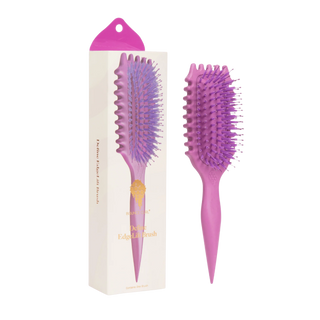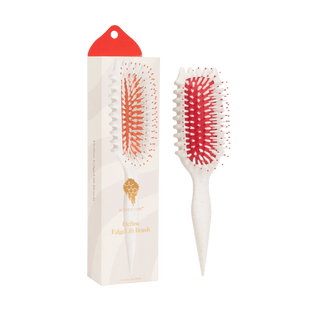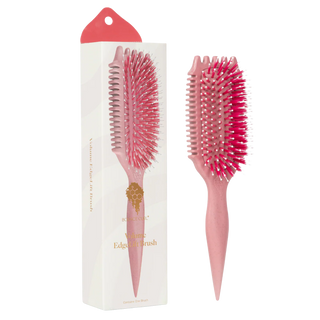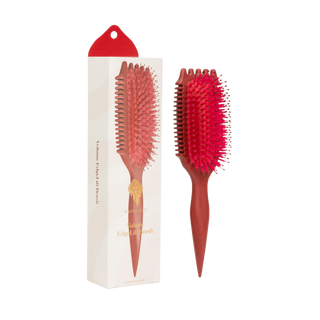
Choosing a curl brush is about how your curls form, how they dry, how they separate, and ultimately how your hair behaves for the next 24–72 hours. That is why Bounce Curl’s EdgeLift system has become such a reference point in the curl world.
At the core of the lineup are two flagship tools: the Define EdgeLift Brush and the Volume EdgeLift Brush. They look similar at first glance, but they are engineered for noticeably different outcomes.
And then there is the growing category of “dupes,” which often look almost identical on social media, but do not always behave the same once they meet real curls.
The EdgeLift Concept: Why these brushes are not “just brushes”
The Bounce Curl EdgeLift brushes were designed by formulating scientist Merian Odesho, combining structured curl science with a very specific styling philosophy: curls form best when they are guided into controlled clumps under consistent tension.
Across the range, the brushes share:
- The signature EdgeLift handle for control and sectioning
- A structured bristle layout designed to shape curl clumps
- A focus on tension-driven definition rather than loose detangling
But what really changes everything is not the shape of the brush. It is how the bristles behave under pressure.
Define EdgeLift vs Volume EdgeLift: the real difference
Define EdgeLift Brush: control, structure, polish
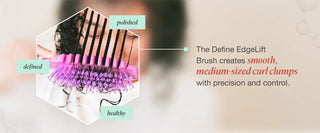
The Define brush is built for precision styling and uniform definition.
It creates medium-sized curl clumps, meaning curls tend to group together in more consistent, even sections. The result is a smoother, more “finished” look with less randomness in curl formation.
Its bristle system is designed to:
- Apply higher, controlled tension
- Smooth the cuticle while shaping curls
- Encourage consistent curl direction
Result in real life:
- More uniform curl pattern
- Stronger definition
- Reduced frizz
- A polished, structured finish
This is the brush for days when you want your curls to look intentional, styled, and refined.
Volume EdgeLift Brush: lift, separation, fullness
The Volume brush takes the same foundation and shifts the outcome completely.
Instead of guiding curls into medium clumps, it encourages smaller curl groupings, which increases separation and overall density.
Even though it still uses tension, the geometry changes how curls “release” after styling.
Result in real life:
- More curl pieces = more visible volume
- Lighter, airier shape
- Enhanced bounce and movement
- Better revival on second or third-day hair
This is the brush for curls that feel flat, heavy, or too “bundled” together.
So what is the actual difference between Define and Volume?
It is not about one being stronger or better.
It is about clump architecture:
- Define = fewer, larger curl clumps → smoother silhouette
- Volume = more, smaller curl clumps → fuller silhouette
Think of it as editing:
- Define “edits” curls into a clean, controlled pattern
- Volume “expands” curls into a more dimensional shape
Where dupes enter the conversation 👀
This is where things get interesting.
At first glance, most dupe brushes look extremely similar:
same general shape, same “EdgeLift-inspired” design language, sometimes even similar packaging claims.
But the key question is not how they look.
It is how they behave under tension.
What often differs in dupes:
1. Bristle flexibility
Original EdgeLift brushes are calibrated for a specific tension balance.
Dupes often feel either:
- too soft → curls don’t form properly
- or too rigid → creates breakage or uneven clumps
2. Clump formation consistency
The Define and Volume brushes are engineered to control exact curl grouping behavior.
Dupes may still style, but often fail to consistently produce:
- medium uniform clumps (Define effect)
- small separated clumps (Volume effect)
3. Cuticle smoothing effect
The vegan boar-style bristle blend in the original line is designed to smooth while shaping.
In dupes, the smoothing effect is often weaker, leading to:
- more frizz
- less shine retention
- faster curl expansion after drying
4. Longevity and stability
Over time, some dupes lose structure in the bristles, which directly impacts performance consistency.
The honest truth about dupes
Dupes are not automatically “bad,” and they are not identical across brands.
Some work decently as budget tools for basic styling.
But what they usually do not replicate fully is:
- the engineered tens ion system
- the controlled curl-clump architecture
- the predictable Define vs Volume separation logic
In simpler terms:
A dupe can mimic the shape of the brush.
It cannot always mimic the behavior of the system behind it.
Define vs Volume vs Dupes (simple breakdown)
| Type | Curl Formation | Finish | Predictability |
|---|---|---|---|
| Define EdgeLift | Medium clumps | Sleek, controlled | High |
| Volume EdgeLift | Small clumps | Full, airy | High |
| Dupe brushes | Inconsistent clumps | Varies | Medium to low |
Final thought: why this comparison actually matters
Curl tools are not just styling accessories. They actively influence pattern formation.
That is why the difference between Define and Volume is not cosmetic. It is structural.
And that is also why dupes often sit in a grey zone. They may resemble the tool, but not always the engineered result it was designed to produce.
Ultimately, the choice is not only about price or branding. It is about whether you want:
- a predictable curl system
or - a flexible, experimental alternative
Both can have a place. But they are not always interchangeable.